Transit safety is a top regional priority, and leadership continues to take a very active role in addressing challenges, implementing changes and helping the community regain confidence in the system that serves the St. Louis region. Today, a virtual “Talking Transit” event was held by Citizens for Modern Transit to serve as a forum for transit security updates. Those in attendance received valuable insights and updates on the $52 million Secure Platform Plan, a metal detector pilot program, efforts to increase law enforcement presence on MetroLink and MetroBus and other means to address challenges and implement change.
The discussion featured Taulby Roach, President and CEO of Bi-State Development; Kevin Scott, General Manager of Security for Bi-State Development; Catina Howard, Vice-President of the ATU Local 788 and Kathy Osborn, President & CEO of the Regional Business Council. The forum was moderated by Kimberly Cella, Executive Director of Citizens for Modern Transit.
“Our region has been challenged,” stated Roach. “In response, we have reinvigorated partnerships between the St. Clair County Sheriff’s Department, the St. Louis Metropolitan Police Department and the St. Louis County Police Department, along with Transit Security Specialists and Contracted Security through Metro Transit. Together we are embarking on a very ambitious, fully layered security strategy that keeps riders safe and comfortable and is designed to constantly evolve.” Bi-State Development operates the Metro Transit public transportation system in the City of St. Louis and St. Louis County in Missouri and in St. Clair County in Illinois.
Portions of this strategy discussed during the forum, included the following updates:
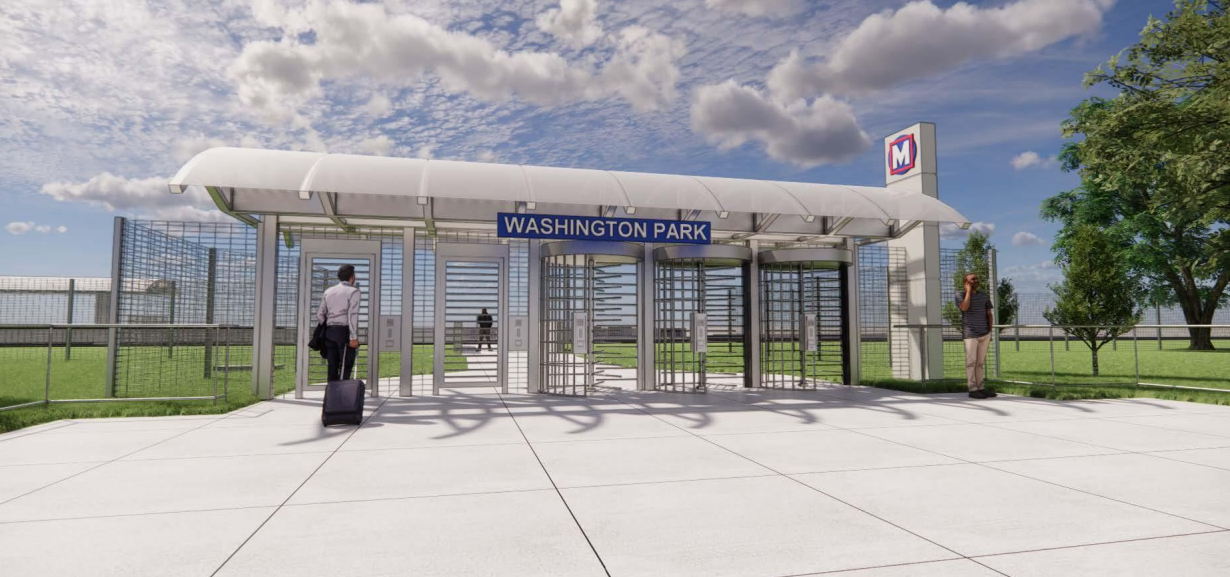
- The $52 million Secure Platform Plan (SPP) is a fully layered security strategy that will add gates, fencing and new security cameras, along with the integration of a new fare collection system, at each of 38 existing MetroLink stations and the new MetroLink station planned at MidAmerica St. Louis Airport. A phased implementation approach is moving forward expeditiously and aggressively. The first phase includes the installation of gates and fencing at four MetroLink stations in East St. Louis and the eastern edge of Belleville, including Jackie Joyner-Kersee, Emerson Park, Washington Park and College Stations. Phase one is going to bid in August 2023 and is expected to be complete by the end of Q1 2024. Phase two – which includes the Cortex, Delmar Loop, Forest Park-DeBaliviere, Grand, Union Station, Central West End and Civic Center MetroLink Stations – is already in progress with final design underway. Phase two is expected to go to bid in November 2024 and be completed by the end of Q2 2024.
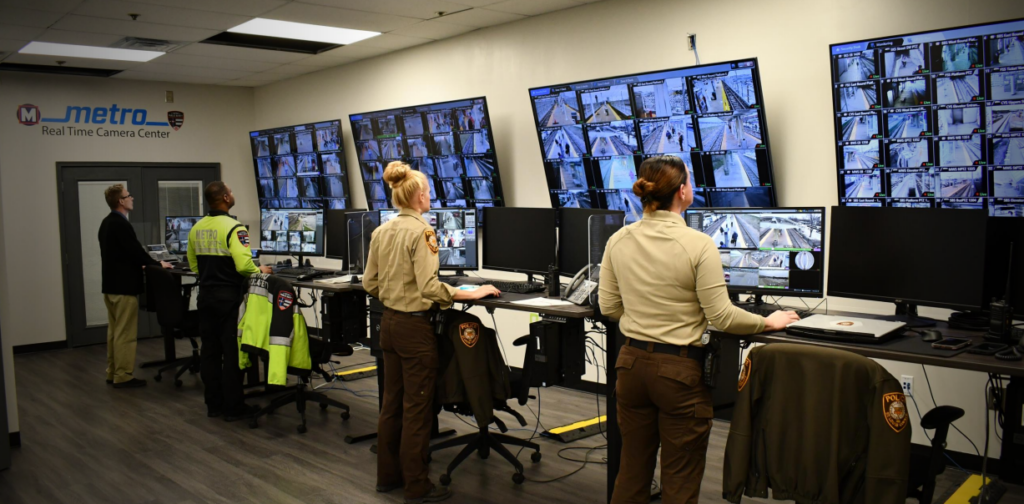
- The new Real Time Camera Center, which is at the core of the SPP, is now fully operational. It features a Closed-Circuit Television system where the system is proactively being monitored 24 hours a day, seven days a week. When all phases of the SPP are complete, the number of camera positions will increase from 800 to 1,600. Those riding MetroLink and MetroBus will also be monitored on camera.
- Law enforcement partners and Metro Transit’s contracted security team are currently providing onsite coverage of the MetroLink system, while the 52 internal Transit Security Specialists are riding on MetroBus routes and taking a zoned-approach to covering the vast bus operation areas so they can more expeditiously respond to occurrences. Metro Transit recently committed $750,000 to cover overtime wages to help further increase the law enforcement presence through the summer months on MetroLink and at MetroLink stations.
- Metro Transit will roll out a four-week metal detector pilot program in the near future. Mobile metal detector equipment will be rotated through various MetroLink stations in Missouri and Illinois to establish checkpoints. Outcomes from this pilot will determine next steps, but Metro Transit officials reinforced that the system will never have TSA-type scanning capabilities as it is simply not feasible.
- Actively addressing mental issues has also been an area of key focus. A pilot program initiated by the St. Clair County Transit District, in partnership with Chestnut Health Systems™, has been expanded to two high-volume transit center locations in Missouri and on board MetroLink trains in Missouri. A total of $1.5 million has been dedicated to the program to place four teams of behavioral health providers on the system to help reduce loitering; address behaviors impacting operations, including alcohol and drug use, sleeping and argumentativeness; provide early detection and intervention for riders who need services; and improve overall rider experiences.
“We are working to produce first quarter numbers for 2023, but we currently have far less than one percent of incidences on the MetroLink system itself and when compared to the broader communities we are in a solid position,” stated Scott. “We will never reach a point of euphoria where nothing will ever happen. That is just not realistic. We will always face challenges. That said, all these layers will work in concert to mitigate as many problems as we can.”
As part of the insightful conversation, Howard of ATU Local 788, which represents transit operators, reinforced that these individuals are on the frontline experiencing the safety and security issues first-hand. She understands that this strategy is a process and Metro Transit is working hard to make changes, but more needs to be done and a community piece is missing. “We have to engage the community on this and get all eyes on the situation,” noted Howard. “Some of our passengers need to understand why it is important to make transit safe and enable our city to grow.”
The discussion all came down to the key point that transit needs to be able to safely get people from where they are to where they need to be. Many use it for entertainment purposes and to get to games, but a huge segment of the population uses it to get to work, school and to access essential services. “Public safety is about perception and reality and knowing the difference,” stated Osborn. “We have to make the transit system safer so perception over time changes. Transportation is the number one issue in terms of growing our economy.”
CMT hosts quarterly “Talking Transit” events to keep members, elected officials, stakeholders, transit riders and others in the loop on issues and efforts influencing the local transit system. These educational gatherings feature guest speakers and panel discussions addressing a wide range of topics, including transit-oriented development, safety and security, best practices, service changes and more.